Aw, shucks! Seaweed Blonde and Oyster Stout.

Updated: Feb 13, 2021

Have you ever heard of a Fish Bladder IPA or a Seaweed Blonde Ale? How about an Oyster Stout? You’ve likely never heard of the first two – for good reason – they sound disgusting. You very easily could have heard of the third one and you may have even tried one before. However, I can assure you, you’ve tasted far more Fish Bladder IPAs and Seaweed Blonde Ales than Oyster Stouts.

The Flaggy Shore

Before I explain myself, let me take you on a trip to Ireland. My parents, my siblings, and our SO’s rented a cottage on the west coast, just south of Galway in the Burren, on the Flaggy Shore. It’s a very rural part of the country, filled with low green hills, dotted with grazing cows and partitioned by ancient stone walls. Waves calmly brush up against the shore that is more stone than sand, leaving behind strands of seaweed. The smell of the ocean permeates everything, laced with peat smoke. Along the shore, within stumbling distance of our cottage, is a pub, a favorite of the local fishermen.

Linnane’s Lobster Bar

One night, I’m sitting in the pub next to the fire, talking to a local about many things, most pertinent here being beer. We were likely on our 3rd or 4th Guinness at that point in the conversation. I pointed toward a shelf behind the bar, near bottles of Jameson and gin, where a dusty bottle of Oyster Stout rested. “How’s that?” I asked my new friend. “Never tried it. Why would I when we have this?” he replied while lifting his Guinness. So it goes.

I noticed many bottles of Oyster Stout on shelves behind Irish bars, more as an oddity than an offering as few had any fresh or any at all in stock. One pub had a draught line dedicated to oyster stout, but sadly, it was sold out when I visited. There was plenty of stout, and plenty of oysters, but never did they comingle in the bottle.

Back in the US, a few breweries occasionally release an oyster stout (I’ve had 3 or 4 commercial examples). I’m not aware of any that have one as a flagship. That is entirely understandable as the consensus appears to be to turn one’s nose up at the thought of oysters in beer. Which is a shame, as anyone that has paired a stout such as Guinness with well-prepared oysters can tell you that it is a lovely combination. The dark roasty beer mixing with the brine of the oyster takes me back to Linnane’s.

Chef Juan is a master shucker.

The origin story of Oyster Stout is (allegedly) that breweries on the coast with easy access to oysters discovered that adding shells to the boil would cause the beer to drop more clearly, resulting in a more attractive pint – without affecting the flavor of the beer. This went on for some time amongst brewers until one such pub brewer, likely seeing his or her patrons slurping oysters alongside porter and stout thought to cut out the middleman and added the oyster meat into the beer as well.

I don’t know how true that story is, but there’s reason to believe it. Calcium does help a beer drop clear and oyster shells are loaded with calcium. Fish bladders and seaweed also help beers drop clear and are prevalent enough that the last beer you drank likely had one of those two ingredients added to it (I told you I’d come back to why I asked you that question). And the decision to add the meat to the beer? Admittedly the first person to do so was likely a little strange (/brave), it is a totally valid way to cook oysters – they pick up the flavor of the beer!

A stainless steel strainer helps fish them out

I pitched the idea of brewing a small batch of oyster stout for our Valentine’s Day Beer Dinner (wink wink, nudge nudge) to the other managing partners and they looked worried, but to their credit, they didn’t say no(!). So I worked with our head chef Juan to source and shuck enough oysters to get over 2 pounds of meat. Two pounds of shells (which was a little less than half the total shells) were added at the start of the boil and then in the last 5 or so minutes, I boiled the meat in a strainer so I could easily pull them out. Juan then promptly battered and fried the oysters, which made for a delicious meal as the stout cooled down on its way to the fermenter.

That 2 pounds of meat wasn’t exactly an arbitrary decision. From what limited information I could find online, it looked like you want to use between 2 to 6 pounds of oyster meat per barrel of beer (between 1-3oz per gallon). That’s quite the range. From my experience, too few oysters and it’s just another beer – not even perceptible on the palate. Too many and you have fish soup beer. Somewhere in the middle, you get an increased perception of sweetness thanks to the salinity of the oyster liquor and whiff of coastal character, not unlike a mild Islay Whiskey.

What it doesn’t taste like, is oysters. So if you’ve never tried oyster stout before, your chance is coming up soon with the release of Father of Perl. To quote one of the initially skeptical partners when he tried it, “Hey! This actually isn’t bad. It’s good!”

Hindsight is 2020 – Looking back and ahead

I’ve missed a year-end post by a few days, but better late than never. I’ll try not to get too sentimental. 2020 was a bit of a dumpster fire for the world and was for many people the worst year of their life. We’re all happy to see the year behind us, but it’s wise to remember that changing the calendar does not make our problems go away… I’m not here to talk about that though. I have been extremely fortunate in that I’ve been able to keep my job(s) and my health in 2020. I even helped start a brewery. So let’s talk about one of the unexpected (at least to me) challenges around that.

Looking in 11 months ago

The normal arch for a pro brewer seems to be that they start at the bottom, maybe volunteering at a brewery to help clean kegs, then getting hired on as a cellarman, then assistant brewer, and finally head brewer. After enough experience with that, they make the leap and open their own brewery. I have the utmost respect for those who follow that path. It is a tremendous amount of work and dedication. I did not follow that path. I had the opportunity to jump right into the deep end and I did so – without knowing how to swim. So far, I have not drowned.

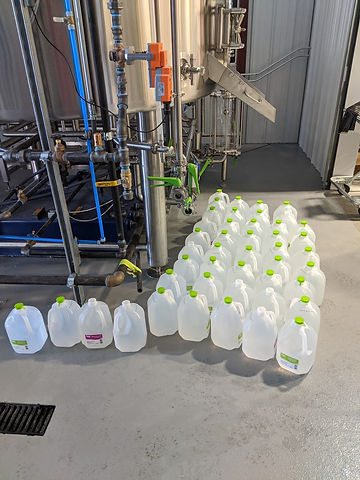
Our RO system wasn’t working yet on our first test batch so we had to improvise

I’ve been homebrewing for about a decade and a half so I wasn’t entirely unprepared. The process is largely the same, just bigger and most steps take longer. Plus there is dangerous equipment and chemicals that don’t exist at the homebrew scale. Homebrewing does not prepare you for necessary bits of pro brewing of maintaining a cellar, keeping a large draft system clean and balanced, keeping the beer people love in stock, and not making too much of the stuff they don’t love as much.

That last bit has been the biggest challenge for me. I hardly know what I want to drink on a given day, let alone what the public wants to drink. So I started with a few of my personal favorite recipes with the hope that people would have similar tastes. And they did! We received mostly positive feedback from those initial brews. Some of them have come back already and some will come back in the future, but I have many more recipes to try out.

Our first troll HATED our initial selection of beers and let us know how wrong we were.

In my other life, I often write short programs to automate a process or make insights into data when there’s too much to manually parse through. So I created a program that looks into our POS data and calculates a “popularity” metric for each beer. It’s essentially ounces sold per day. This isn’t perfect, of course. When we only had 5 beers on tap, those 5 skew higher than beers when we have 20 on tap. Slowdowns due to weather or COVID restrictions skew the results down just as busy weekends skew upwards. Imperfections aside, this data point gives me a rough idea of what people like to drink. So here’s our top 10 for 2020 in descending order:

1. Rye-Ryetoberfest

2. 80 East to Ariana

3. Moliner Weisse

4. Cherry Pylon

5. The Gold

6. Ryetoberfest

7. 80 East To Amarillo

8. Merry (cran) Berry

9. Liffey

10. Mango Milkshake IPA

What does this tell us? Should I just brew barrel-aged Ryetoberfest year-round? Maybe… but I’d probably be haunted by my German ancestors for brewing an Oktoberfest out of season. Should I throw out all versions of 80 East except for Ariana? No – I feel like variety is important and Ariana was sold during beautiful weather and with far fewer COVID cases in the QCA. 80 East Amarillo is likely the more “popular” beer given proper context.

So what does this data show? Honestly, I don’t know yet, but it’s been fueling a lot of my thoughts around what I’ll brew in 2021. I’m certainly taking a more strategic approach to filling the tap rails. I plan on always having a fruited sour on and always having a Pylon on. More barrel-aged beers and more juicy hop bomb IPAs too. And The Gold and Liffey aren’t going away anytime soon. There will be plenty of new stuff too! I have a notebook full of recipes I’m excited to introduce to everyone.

Cheers to you all and here’s to 2021!

“Do a barrel roll!” – an update

It’s been a minute since I last made a post here. These past few months in particular have been a whirlwind. This past weekend was the first time I hadn’t brewed since February. Oofda. Sounds like a good time to get you up to speed on what I’ve been working on, and what’s in the works. Let’s start with barrels!

I consider barrel aging one of those “next tier” brewing practices. Barrels introduce so many variables into the brewing process that a new brewer absolutely should not jump right in. Thankfully, I’m not a new brewer. I have had a 5 gallon bourbon barrel in my home cellar for a few years that generated a few excellent “clean” beers before becoming a sour solera. I love the extra flavor and depth you can pull out from a barrel in a relatively short time. So I was pretty excited when Mississippi River Distilling Company just up the highway from us offered some of their barrels. The first beer to barrel age was easy – Ryetoberfest already had a significant amount of rye malt in it so why not add it to a rye whiskey barrel? That proved to be an excellent idea and beer.

Next up, I added a dark braggot I’ve named Panna Moon to one of their bourbon barrels. The first resident in my home barrel was a mead that was phenomenal. If you like honey whiskeys, this was sort of the inverse of that – honey up front with whiskey notes. That beer is still hanging out in the barrel, and I’ve kept myself out of it the past month or so in order to prevent me from “over-sampling”.

There’s another bourbon barrel hanging out, waiting for some of the behemoth Quad City Quad to come over and hang out. Soon, friends. Soon.

In the middle of starting this barrel program, John from nearby Cat’s Eye Distillery reached out and asked if we were interested in using their barrels. With eclectic whiskeys like Krupnik and their Obtanium series, these guys definitely have the mad scientist mindset so many homebrewers excel at. We recently stopped by to pick up a barrel and got a tour and a few samples. There are barrels of all shapes, sizes, colors, and ages looming over a collection of homemade and retrofitted gear. Big homebrew energy in the best way possible. The samples we tasted were all excellent and the barrel we picked up is a beauty. It started its life at Heaven Hill well over a decade ago, then hosted Toppling Goliath’s ultra popular Kentucky Brunch Brand Stout. It then hosted Cat’s Eye Kentucky Whiskey. That’s quite the pedigree to live up to but I think we can put something tasty in it. Something for our 1 year anniversary perhaps…

There’s a lot more to catch you up on, but that’s it for now! Cheers!

The Nose Knows

The first time I smelled Brett(anomyces) in a beer, I instantly thought about my long-passed grandmother. That surprised me. She didn’t drink beer, at least not around me, and certainly not barrel aged beers.

I dug into that memory a little deeper – what specifically about her was I thinking about? And I realized it was her basement. She had a very old house and even older cellar, the kind that really put the “root” in “root cellar” – stone walls and dirt floors. I never spent much time in the basement as it spooked me out as a kid, but that musty smell of wet earth and stone stuck with me, buried deep in my subconscious to be resurrected by a beer of all things.

Some people get “barnyard” or “horse blanket” from Brett. Having spent a considerable amount of time growing up in barnyards and around horses, I can’t say I understand the connection. But damp basement, Brett has that in spades.

A flavor and aroma descriptor used to describe beer an awful lot (image source) Am I wrong for linking Brett to basements instead of the textbook descriptors of farms? Absolutely not. Studies have shown that your sense of smell is one of, if not the, strongest sensory link to memories. It makes sense given just how close your nose is to your brain.

It’s easy to fall into the trap of thinking about what you should be smelling or tasting and letting that get in the way of what you’re actually smelling or tasting. If a beer smells like stale Cheerios or a candy from your childhood (or even cat urine) – don’t ignore it, but rather lean into it and see if you can find the source. A beer that smells of circus peanuts and strawberry starburst is way more interesting than vaguely saying a beer is “fruity”. Trust your instincts. The nose knows.

For the love of beer gardens

For many, when they think of drinking in Germany, they think of long skinny tables surrounded by people crowded shoulder to shoulder drinking liter mugs of beer while wearing lederhosen or dirndls.

That kind of thing absolutely exists – for a couple weeks each year. The rest of the year, the drinking scene is much more relaxing. Think of a quiet courtyard with an ornate fountain in the middle, paved pathways winding between wooden picnic tables sitting on soft gravel, big chestnut trees providing ample shades, swaying ever so slightly in a summer breeze. There may be music playing in the distance, but likely you’ll just hear the clink of plates and glasses along with quiet conversation and occasional laughter. This is the typical German biergarten and I don’t know about you, but I’d pick that any day over a packed noisy tent.

Every town, regardless of its size, seems to have at least one biergarten in Germany. Some may have ornate sculptures scattered amongst dozens of tables and some may just be a few tables with umbrellas on top of a gravel lot. Some even have a playground for the kids to enjoy while the adults enjoy their drinks. And the question on whether a garden is “family-friendly” doesn’t even seem to cross the average German’s mind – of course they are – biergartens are meant for family and friends to gather.

That clashes a bit with the American drinking culture. These gardens call for a measure of subtlety and there isn’t a whole lot we do subtly – including drinking. The American beer drinking culture largely started with German immigrants and there are accounts of them attempting to create biergartens in 19th century America and not always seeing eye to eye with their hard-working, hard-drinking clientele.

We now have far more breweries than America or Germany has ever had and with that increase in options, I’m starting to see some biergartens pop up in the US. I’m hoping we can contribute to that picture at Twin Span with our patio. We already have huge Bavarian style pretzels and with our Keller Pils and Hefeweizen, we have the same beer options as many biergartens. Now we just need some chestnut trees (lederhosen optional).

I started brewing out of spite

No, really. It was one of those moments where I was challenged and my response was “Oh yeah?? I’ll show you!” In other words, this post is about my brewing history.

To wind the clock way back, when I was 7 years old I had an uncle hand me a warm can of Busch Lite and told me to give it a taste. I did and he chuckled. I don’t condone giving beer to minors but it was effective in me not wanting to try beer again until I was in college. It was in college that a friend of a friend left a few bottles of Killians in my fridge and suggested I give it a try. It was my first exposure to beer that wasn’t – well, in my mind at least – beer flavored

I began seeking out different styles and flavors. I quickly became a Guinness devotee. Sierra Nevada Pale Ale, Rogue Dead Guy, et al. I remember buying a six pack of RedHook ESB and thinking it was way too bitter so I left it in the fridge. Just a couple months later after cutting my teeth on far more bitter beers, I returned to it and realized how well balanced it actually was.

It wasn’t long before I became the worst kind of craft beer convert – a snob. I am truly embarrassed about this phase, but fortunately it didn’t last long. I turned my nose up at what my fellow college student friends were drinking, goading them into trying what I liked. During one of those rants, one of them got fed up with me shitting on their beer brand of choice and said “Like you could make something better!”

Like Biff Tannen calling Marty McFly a chicken, I had been triggered. I immediately set out to learn how to brew beer. If anything, I could justify shitting on what I considered bad beer if I could make something good. So I bought a Mr. Beer kit and brewed an Amber Ale that was… it was bad. A lot of people end their brewing hobby at this point. I was not going to cede defeat. I bought a food grade bucket, the cheapest stock pot I could find, a big spoon, and a copy of How to Brew (all of which I still have, 14 years later). I was going to make good beer, damn it.

My first extract kit turned out pretty well. My second one blew up. Literally – the fermenter cork jammed and when it popped off, all 4 walls, floor, and ceiling were painted in beer. What I was able to save was even better than the first beer! I got cocky and started experimenting with recipes – loads of kiwis, unique sugars, Mountain Dew instead of brewing water (best not to dwell on that one), and so on. Online resources were scant and I didn’t know any other brewers so it was mostly all self-taught from trial and error.

Eventually I met another brewer through a college class. We challenged each other on styles and compared notes. I started seeking out and reading every book and magazine I could find on brewing to get a competitive edge against my friend. I participated in a couple crowd-sourced brewing experiments through one of the brewing magazines, challenging the established brewing myths (secondary fermenters are a lie!).

A few years into the hobby, brewing in a small apartment kitchen. OG brew kettle on the stove in the background.

A corner of the bedroom closet in that apartment converted into a fermentation chamber

I moved to the Quad Cities during this and one such experiment was published with my name and city, which prompted a member of the local homebrew club, MUGZ, to recruit me into the club. At the first meeting I attended, my mind was blown at the quality of beers homebrewers were making. I had so much to learn. I attended every meeting, taking notes from the other brewers, getting feedback on my own beers, and making a lot of good friends. I nervously served my own beer at homebrew festivals and was surprised when people actually liked my beer.

I was actively seeking out new beers and breweries along the way. I had (and still have) a supportive wife that liked beer as well. We’d frequent New Glarus, check out new breweries in Chicago, and even went on a tour of the Rogue brewery on our honeymoon. For a while, I was fortunate to have a job where I traveled all over the country and I made sure to stop at as many breweries as possible in my free time on those trips. I’d seek out the brewers when possible and chat about their beer. I traveled to Germany a few times and Ireland, drinking their classic styles at the source.

I began judging at beer competitions and submitting my own beers for feedback. Some fellow homebrewers and I were picked to brew a beer at Bent River. My first taste at brewing something professionally people actually wanted to buy. I started noticing various members of MUGZ going pro themselves, but didn’t really consider it myself since I couldn’t think of any way to make it work with my day job. I was happy to collaborate with my friends that did brew professionally – I brewed a couple beers at Rebellion, and there was a pro-am collab with Wake.

At this time, I’d been obsessing over beer for over a decade. My home setup had transformed from a pot and bucket to a semi-automated electric brewery with stainless steel conical fermenters. I’d read just about every modern book on brewing. I wanted a challenge. I started looking into the Cicerone program. It’s a test for beer experts with a less than 33% pass rate. I started studying.

I studied for about a year and half before I took the test and I learned so much more about beer history, tasting, recipe design, and brewing. My own beers started to noticeably improve as well. I started chatting up someone from work about what I was working on and after a while he asked me if I wanted to open a brewery with him. We started planning, I passed the Cicerone test, and here we are.

And somewhere along the way I completely forgot which friend challenged me to shut up and actually make good beer.

My brewing setup these days.

The first of many words about beer

Beer will save the world – if we allow it to. I truly believe that. There’s a mildly interesting story behind how I came to that revelation that I’ll share with you sometime over a few beers. Until then, you’ll have to just take my word on it.

I have a lot of words on beer. Beer is very much my obsession and passion. I talk about it with whomever will listen, often at times when I should be talking about something else. That fact is a big reason why Twin Span Brewing exists in the first place.

So consider this the formal start on our conversation about beer. I leave my own notes in each beer description, but I’d like to expand that conversation here in a blog. As much as I’d like to, I can’t sit down and have a pint and a chat with all of you, so this will have to do. So let’s get started on saving the world. Cheers!